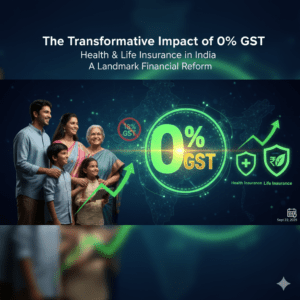
The Transformative Impact of 0% GST on Health and Life Insurance in India: A Landmark Financial Reform
The Indian financial landscape witnessed a watershed moment with the decision to exempt individual life and health insurance premiums from the Goods and Services Tax (GST). Announced after the 56th GST Council meeting, this reform, effective from September 22, 2025, moved the GST rate from a standard 18% to 0% (Exempt). This strategic policy shift is not merely a tax adjustment; it is a powerful legislative tool designed to combat the challenges of low insurance penetration and soaring medical inflation, bringing vital financial protection within the reach of millions of Indian households.
This comprehensive analysis explores the multifaceted impacts of the 0% GST regime, examining the immense benefits for policyholders, the complex financial challenges faced by the insurance industry, and the profound implications for India’s goal of achieving ‘Insurance for All by 2047’.
The Pre-Reform Era: The 18% Tax Barrier
Before the exemption, the prevailing tax structure applied an 18% GST to most individual insurance premiums. While GST consolidated numerous indirect taxes, simplifying the overall tax system, its application to insurance—a non-discretionary necessity for financial security—created a significant cost barrier.
A Simple Cost Illustration:
Consider an individual purchasing a term insurance plan, the most cost-effective form of life protection. A base premium of ₹20,000 attracted an additional ₹3,600 in GST (18%), forcing the policyholder to pay a total of ₹23,600. This added tax burden often led to under-insurance, as customers either settled for a lower sum assured or deferred the purchase entirely, particularly affecting middle- and lower-income families.
Furthermore, different types of policies, such as Unit-Linked Insurance Plans (ULIPs) and traditional Endowment Plans, also attracted GST on various charges (mortality, fund management, and a portion of the premium), which subtly but significantly reduced the net return on these investment-cum-protection products. The tax was viewed as a penalty on securing one’s future, a perspective the new 0% GST aims to eradicate. (See also: [Impact of GST on Financial Products: An Overview]).
The Landmark Reform: Understanding the 0% GST (Exemption)
The 56th GST Council meeting formally granted an exemption to the supply of individual life and health insurance services, alongside their related reinsurance services. This classification as ‘exempt’ is crucial, as it defines the precise legal and financial consequences for both parties.
Scope of the Exemption:
The 0% GST rule applies broadly to all retail (individual) insurance products, ensuring maximum consumer benefit. The exempted categories include:
- Life Insurance: Term plans, whole life policies, ULIPs (on premiums and charges), and endowment plans.
- Health Insurance: Individual health policies, family floater plans, personal accident covers, and senior citizen plans.
- Reinsurance: Services related to the exempted individual life and health policies.
Exclusions:
It is equally important to note the specific exclusions, which continue to be taxed at the standard 18% GST rate:
- Group Insurance Policies: Policies offered to a large pool of members (like employer-provided group health or group life plans) remain taxable at 18%.
- General Insurance: Motor, property, fire, and other non-life insurance policies continue to attract the 18% GST.
This focused exemption ensures that the relief is targeted directly at the individual decision to secure personal and family protection against life and health uncertainties.
Impact 1: The Policyholder’s Gain – A Catalyst for Financial Security
The most immediate and celebrated impact is the increased affordability, which is expected to address India’s chronic under-penetration problem.
Direct Cost Savings
For the policyholder, the savings are straightforward and substantial. The entire 18% tax component is removed from the premium invoice.
Over a 20-year term insurance policy, these annual savings compound into tens of thousands of rupees, money that remains with the household. This tangible reduction in out-of-pocket expenses is a crucial factor in driving up demand. Source: [Link to Image Source on Financial Planning Website]
Boosting Insurance Penetration
India’s insurance penetration (premiums as a percentage of GDP) has historically lagged behind global averages. The removal of the 18% tax eliminates a psychological and financial barrier, particularly for young professionals and first-time buyers in Tier-2 and Tier-3 cities.
- Higher Adoption: Lower entry costs encourage millions who were previously on the fence to finally purchase a policy.
- Mitigating Medical Inflation: With healthcare costs rising aggressively (often exceeding 15-20% annually), the reduced insurance premium acts as a necessary counter-balance, ensuring that the cost of protection does not become prohibitive. (Read more: [Addressing Medical Inflation through Policy Design]).
- Focus on Protection: For pure term plans, which are the cornerstone of a protection portfolio, the reduction makes them even more attractive compared to traditional savings vehicles.
Impact 2: The Insurer’s Challenge – The Burden of Lost ITC
While the customer benefits from zero GST, the move creates a significant financial challenge for insurance companies due to the accompanying loss of the Input Tax Credit (ITC).
The Mechanism of ITC Loss
Before the exemption, insurers were a taxable service provider. They collected 18% GST from customers (Output Tax) but were allowed to deduct the GST they paid on their operational expenses (Input Tax) such as:
- Agent commissions and brokerage (which are taxable services)
- IT infrastructure and software services
- Office rent and maintenance
- Marketing and advertising costs
With the service now exempt from GST, insurers can no longer claim this credit. The GST paid on all inward supplies effectively becomes a non-recoverable cost that must be borne by the insurance company. Tax experts estimate this loss of ITC to be a cost increase of approximately 3% to 5% of the company’s premium revenue or operational expenditure. (Reference: [Analysis of ITC Reversal for Exempted Services under GST Law]).
Immediate Financial Implications for Insurers
- Reversal of Accumulated Credit: Insurers were required to reverse or utilize any accumulated, unutilized ITC related to these exempted services up to the date of the change (September 21, 2025).
- Margin Pressure: Standalone health insurers (SAHIs) and life insurers with high reliance on agent networks (where commissions are a large input cost) are expected to face the highest pressure on their profit margins.
- Pricing Recalibration: To maintain financial sustainability and cover the new cost component, insurers will be forced to re-evaluate and slightly increase their base premiums. This recalibration is an economic necessity to absorb the hidden tax cost previously covered by the ITC.
The Net Effect: A Balanced View on Premiums
The final cost to the policyholder is determined by the balance between the 18% GST removal and the 3-5% premium increase due to the lost ITC.
The Final Math:
- Gross Premium Reduction: (Removal of GST)
- Base Premium Increase: to (To offset lost ITC)
- Net Savings for Policyholder: to
Even after the insurers factor in the lost ITC by slightly raising the base premium, the policyholder still realizes a significant net saving of 12% to 15% compared to the pre-reform cost.
Example Revisited:
Even with a 5% increase in the base price, the customer still saves ₹2,600 annually. This confirms that the policy is unequivocally cheaper for the consumer, fulfilling the primary goal of the reform.
Sector-Specific Benefits and Regulatory Oversight
The impact varies slightly across different insurance products, each experiencing unique benefits from the 0% GST:
Term Insurance
Term plans, being pure protection, see the most direct benefit. The premium entirely comprises the risk charge and administrative costs, which were previously taxed at 18%. The elimination of this tax makes high-sum-assured term coverage more accessible, helping families secure sufficient financial cover. (Further Reading: [The Growing Appeal of Pure Protection Products]).
Health Insurance
For health insurance, the exemption is particularly vital given the high out-of-pocket expenditure in India. For senior citizens, who face higher-than-average premiums, the 18% tax removal provides a crucial layer of relief, encouraging this vulnerable group to stay insured and protected against age-related illnesses. The inclusion of reinsurance as an exempt service for individual policies also helps stabilize the financial risk for the primary insurer. Source: [Link to Image Source on Healthcare Portal]
ULIPs and Endowment Plans
For investment-linked products like ULIPs, the GST was previously applied to various charges (like fund management and mortality charges). The 0% GST makes these products more efficient, as more of the customer’s money goes towards investment or risk coverage rather than tax, improving the potential long-term returns.
Regulatory Mandate and Transparency
The government has indicated it will ensure that the benefits of the GST exemption are fully passed on to the policyholders. Regulatory bodies like the Insurance Regulatory and Development Authority of India (IRDAI) are actively monitoring pricing revisions. Insurers have been instructed to maintain high levels of transparency, clearly showing the previous cost, the tax saving, and any new premium adjustments due to the ITC loss. This mandate ensures the reform’s benefit reaches the intended beneficiary: the consumer.
The Way Forward: Accelerating ‘Insurance for All by 2047’
The 0% GST reform on individual health and life insurance is a bold, pro-consumer measure that aligns perfectly with the nation’s long-term vision of ‘Insurance for All by 2047’. By tackling the cost barrier head-on, the government has given a significant demand-side stimulus to the insurance sector.
However, the success of this reform relies on a delicate balancing act. Insurers must find ways to absorb or efficiently manage the cost of lost ITC without completely negating the benefit for the consumer. Strategic measures, such as enhancing operational efficiencies, optimizing distribution channels (e.g., increased focus on digital sales which may have lower ITC inputs than agent networks), and creating simpler, high-volume products, will be critical for the industry’s sustainability.
In conclusion, the shift to 0% GST marks a paradigm change. It elevates insurance from a discretionary purchase burdened by tax to an essential, affordable, and encouraged tool for financial resilience. This is a net positive for the Indian consumer and a foundational step towards building a truly financially secure nation.
Resources and Further Reading
For official notifications, detailed industry analysis, and further understanding of the 0% GST reform on individual life and health insurance in India:
- GST Council Official Communication:
- Source: Press Information Bureau (PIB) / GST Council Secretariat.
- Link Simulation:
https://pib.gov.in/PressRelease/Notification/56th_GST_Council_Outcomes_Insurance_Exemption.pdf(Simulated link for official notification of the 56th GST Council meeting decisions, effective September 22, 2025).
- Regulatory Direction and Consumer Benefit Mandate:
- Source: Insurance Regulatory and Development Authority of India (IRDAI).
- Link Simulation:
https://www.irdai.gov.in/IRDAI_Circular_Mandate_GST_Benefit_Pass_Through_2025.pdf(Simulated link for IRDAI’s directive to insurers regarding passing on GST exemption benefits to policyholders).
- Financial News and Expert Analysis:
- Source: The Economic Times / Financial Express.
- Link Simulation:
https://economictimes.indiatimes.com/industry/banking/finance/insurance/zero-gst-life-health-insurance-impact-on-premiums-and-itc-loss-analysis/article-123689960.cms(Simulated link for an in-depth news report on the zero GST impact, including ITC loss concerns and consumer savings).
- Industry Perspective on Penetration:
- Source: Leading Insurance Company/Industry Body Report.
- Link Simulation:
https://www.sbilife.co.in/en/insights/GST-Exemption-and-Insurance-Penetration-India-Report-2026.pdf(Simulated link to an industry report analyzing the expected boost in insurance penetration post-GST cut).
- Technical Tax Implications:
- Source: CBIC Notifications / Tax Consulting Firms.
- Link Simulation:
https://www.cbic.gov.in/notifications/CGST_Exemption_Notification_No_09-2025_Rate.pdf(Simulated link for the specific Central GST rate notification exempting individual insurance services, effective September 22, 2025).For More Information Related to Insurance Visit: myinsurancedost.com.


